Physiatry Compensation and Bonus – RVU-based versus Income-based
With RVU-based compensation and bonus, either the practice or the employee may be shortchanged, as follows:
Practice has many low-reimbursing payors – Practice is short-changed
In practices with many self-pay (often becomes no-pay) or Medicaid patients (with its lower reimbursement), the practice may be shortchanged by tying compensation and bonuses to RVUs. Although the employed physician meets his RVU work requirement, the lower reimbursement will result in lower practice income which may be insufficient to cover the physician’s compensation and bonus.
Practice has many traditional reimbursing payors – Physician-employee is short-changed
In practices with a payor mix of traditional carriers (Medicare, BCBS), the employee may be shortchanged. Presuming the same level of RVUs are achieved (as in the above example), the practice’s higher income may far exceed the physician’s compensation and bonus

Opinion
I prefer physician-employee compensation and bonuses which are based on income generated by the employee, and not based on RVUs.
- RVUs is a nebulous, difficult to understand term, but dollars and cents is a universally-understood language.
- The more or less income the practice earns based on the employee’s services, the more or less compensation and bonus the employee gets.
Stated plainly: Pay me based on what income I generate, not the number of hours (which will increase RVU’s) I work.
This article Was contributed by Bruno Stillo, Physiatry Billing Specialists. 800-835-4482, [email protected]
Looking for a Physiatrist? Farr Healthcare, Inc. Physiatry Recruitment Has Them
Although there is a physiatry shortage, there are many physiatrists looking for work. These PM&R physicians may, or may not, have an interest in your area or the type of work you have, be it inpatient, outpatient or interventional. Check below to see if one of these physical medicine and rehabilitation doctors is a match for your position. Many more physiatrists are available so if you don’t find one here, please contact us.
- An outpatient physiatrist is looking for work in eastern NC
- A 2024-graduating resident is looking for outpatient work in the Baton Rouge area. Many more 2023-graduating residents and fellows are available.
- An inpatient physiatrist is open to most areas and wants to be the consultant, not the primary doctor
- A physiatrist is looking for telemedicine work
- An interventional physiatrist looking for any type of work but on a part-time basis in IN and surrounding states
- An inpatient physiatrist looking for Medical Director work as an independent contractor in GA
- An inpatient/outpatient physiatrist who wants MI,OH,IN, or TN
- An inpatient/outpatient physiatrist who wants to work in the Houston area a few days/week, every other week as an independent contractor
- An interventional physiatrist who wants NJ or NY
- A 2023-graduating sports medicine fellow who wants in or near Atlanta; Philadelphia; Washington, DC.; Miami, Jacksonville, Orlando, or Tampa Bay, FL;Denver; San Diego; NYC; Phoenix; Salt Lake City; Chicago; New Orleans; Nashville; Austin, Dallas, or Houston; Boston; Seattle; or Charlotte
Maybe you’re looking for work. If so, please refer to practice opportunities here.
Latest Physical Medicine and Rehabilitation Statistics
Here is some current information on the landscape of physiatry today. The field continues to grow! It is now attracting even more qualified medical students.
STATISTICS – as of 3/2025
Total number of Board Certified physiatrists – 15,096
Physiatry residency programs: 90
Number of ACGME-accredited Fellowship programs: sports medicine – 141, spinal cord injury – 25, pediatric rehab – 25, traumatic brain injury – 27, neuromuscular medicine -4, and hospice and palliative medicine – 3, pain – 109
BOARD CERTIFICATION PROCESS
Part 1
The written exam is administered annually in August. It can only be taken post-residency. Applications must be received by the preceding January. 498 first-year graduates took the exam on 8/2024. 86% successfully passed the examination the first time. This is the historic pass rate.
Part II
The oral examination may be taken only after one year of clinical practice fellowship, research, or a combination of these activities in PM&R is completed following residency. The exam can be taken in May; the deadline for registration is the preceding November 15th. 444 first year graduates took the exam on 5/2024. 88% successfully passed the examination the first time. This is the historic pass rate.
Candidates must satisfactorily pass both the written exam and the oral exam in order to be certified by the American Board of Physical Medicine and Rehabilitation. A physiatrist must be recertified every 10 years.
FARR HEALTHCARE DATABASE – as of 3/2025
- 14,798 physiatrists with practice and area preferences for most of them
- 5,772 email addresses
Please refer to Farr Healthcare, Inc.’s website for information about physical medicine and rehabilitation practice opportunities and more.
Executive Physiatry Medical Director Compensation
Recently a physical medicine and rehabilitation physician asked me the average compensation for an Executive Medical Director job. The vast majority of the physical medicine and rehabilitation positions we represent are clinical, not executive. According to salary.com, the average Executive Medical Director salary is $359,636 as of December 27, 2022, and the salary range typically falls between $295,670 and $446,617.
One of the many current clinical Medical Director positions available now through Farr Healthcare, Inc. is in the Houston area. This rehab hospital has great clinical outcomes and an outstanding reputation in the market. For more information about this physical medicine and rehabilitation practice opportunity and many more may be found at www.farrhealthcare.com.
WHAT DO I SAY TO EMPLOYERS ABOUT A PHYSIATRY CAREER GAP?
This is a tricky question. Some physical medicine and rehabilitation doctors don’t address it on their curriculum vitae. Some doctors don’t explain it on their cv but explain it in a cover letter. Other doctors don’t address it unless the employer notice the gap on their cv. What should you do?
It depends on the reason for the gap in your professional physiatry timeline. It could be due to illness, the time spent looking for a new job, time spent caring for a family member, provided childcare, loss/suspension of a license, etc.
Some reasons are professionally acceptable but others like taking the time to find a new PM&R job usually raises a red flag. If the former, let your cv show that your gap isn’t a red flag. There’s a degree to which the reasons for a gap are acceptable. Anything that impacts your license is unwelcome to employers. There is no way to successfully explain this gap.
Regardless of the amount of time you weren’t working in physiatry, it has to be addressed on your cv. If the reason for your gap time is one of the less acceptable reasons, it might serve you well to explain it in detail in a cover letter.
Thinking that your gap won’t be found is not facing reality. Instead, it will cause a delay in your obtaining a physiatry job while at the least the discussion about it ensues. At the worst months will go by in your practice search process and then you will be stopped in your tracks when the gap is discovered and rejection occurs and you’re back to square one.
Regardless of the length of the gap in your physiatry timeline, it should be included on your cv. Of course, normal vacation time is understood. Your cv should include the month and year of every entry in your education and experience sections. Hiring entities, hospitals and payors are very attentive to this information.
Honesty is the best policy. Whatever stress if any you may have gone through during the gap time, being honest on your cv will reduce any further continued stress for you. The less stress you feel, the better you will do in the physiatry practice search.
Preparing to explain the gap is paramount. How to explain a license issue is best done by providing the information from the license board. You can explain your side of the issue in a cover letter.
Each reason for a gap is individual so it’s hard to offer an acceptable explanation to you. Explain your gap and move on. Don’t dwell on it in your explanation. Focusing on it will only make it a bigger issue. Focus instead of your desire and readiness to return to the workforce. Stay calm.
Took time looking for a new job
You can give examples of how you have been proactive but selective about looking for a new physical medicine and rehabilitation job during your career gap. Show how you have thought about what you want from a new job as well as from a new employer. Explain why you think this particular position is a good fit for you and why you would be a good fit within the company at large.
Became a stay-at-home parent
Explain that you took time out to prioritize your family and look after your children. Elaborate on why you now feel ready to go back to physiatry work. Why are you excited about this new phase in your life? Provide details that can prove you are a good fit for the position. Also, make sure to show closure, e.g., the kids are grown and in school. Employers know that family is important, but they also want to be reassured that you won’t treat your role as secondary.
Left the workforce to be a caretaker
There is no need to go into the details of the illness or your responsibilities as a caregiver during your physiatry employment gap. Just like taking time off to be a full-time parent, make it clear that your relative has recovered or you have more support in place at home and can reenter the workforce with no obstacles.
Personal illness
Illnesses and injuries explain career gaps in employment very easily. But, make sure to clarify that these ailments won’t get in the way of you working efficiently. Again, there is no need to provide specific details of the illness or injury unless it directly affects the job you are interviewing for. Show that you are ready and more than willing to return to work, emphasizing why you think the physiatry position you applied for is a good fit.
Took time off to travel
Expound on why you decided to go travelling. If you learned anything through this experience, now is the best time to talk about it. Stress on points such as personal development, better cultural awareness, and gaining new perspectives. At the same time, make it clear that you are ready to return to work full-time. So, also talk about why this particular PM&R job opportunity excites you.
Got fired
Explain that you and your former company had different expectations. Show how you realize that you could have handled some things differently, but through the entire process, you have learned a lot and are excited about the new physiatry opportunity to bring everything you have learnt to your next job.
Got laid off
Briefly talk about why your previous role was made redundant, e.g., budget cuts. Provide examples of key achievements and strong performance while you were in your previous physiatry job. Take time to explain what positive things you have been doing such as moonlighting or locum tenens since having left your previous employer and why you think the position you applied for is a good fit.
Relocation
Relocating from one geographic area to another is a reason why you would have a career gap in your physiatry curriculum vitae. The best strategy is to tell the employer how you spent your time while unemployed, highlighting positives gained rather than the negatives. https://www.jobstreet.com.my/career-resources/job-hunting/career-gaps-explanation/
For more information about cv preparation, please visit here. Featured at the 2021 virtual Annual Assembly, special guests Monica Rho, MD, FAAPMR and Linda Farr, MPA discussed tips and tricks for virtual interviewing and how to compose a winning CV. Note: These sessions are only available for viewing by AAPM&R members.
For practice opportunities with Farr Healthcare, Inc., please visit here.

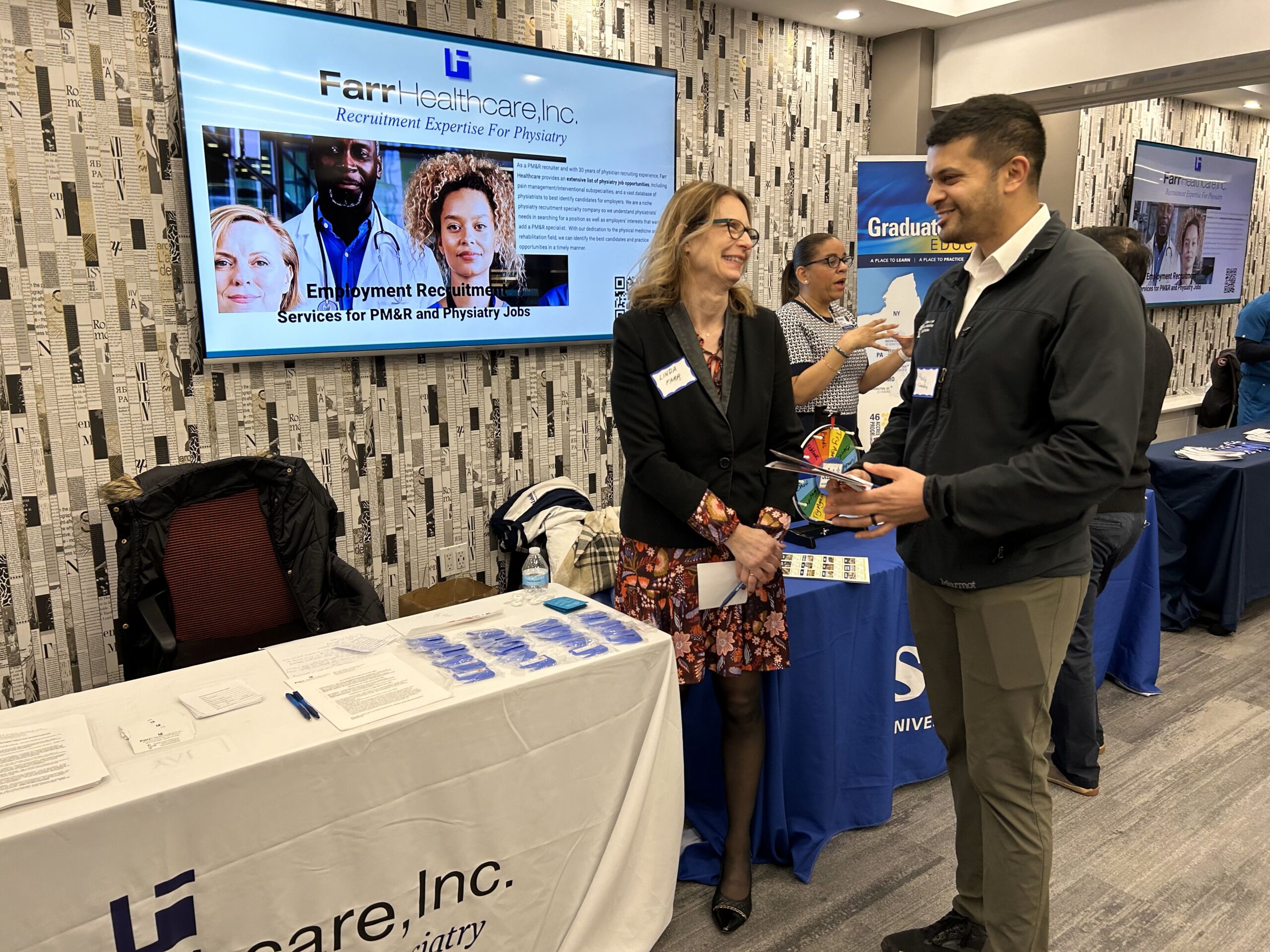
What a Treat to See Everyone Again at the 2022 AAPMR Meeting!
It’s been a few years since an in-person AAPMR meeting. It was great to see everyone at the 2022 AAPMR meeting who stopped by my booth at the Job Fair and/or at the Exhibit Hall. I look forward to seeing all of you next year!
One lucky person won the $500 door prize that we award each year. This year’s winner was Eduardo Lamas Basulto, M.D., a resident from Emory. Congratulations, Dr. Lamas Basulto!
Physical Medicine and Rehabilitation Jobs
Physical medicine and rehabilitation jobs are plentiful! Without an increase in physiatry residency positions, the current national shortfall of physiatrists is projected to persist. According to a study published in the American Journal of Physical Medicine and Rehabilitation on September 1, 2021, without an increase in physiatry residency positions, the current national shortfall of physiatrists is projected to persist. Although a projected increase in physiatrists’ use of advanced practice providers may help preserve access to comprehensive physiatry care, it is not expected to eliminate the shortfall.
Be adventurous and consider a general outpatient opening with EMG’s in OR in the North American wind sports epicenter with world-class skiing, windsurfing, kite-boarding, mountain-biking, and hiking minutes from the practice. Or consider a sports with regenerative medicine physical medicine and rehabilitation job in CO with a practice has it all – it’s busy, growing, well-established AND has great professional collegiality. There are patients there waiting for you; there’s a 3 – 4 months appointment wait time. And, the best as last, a 4-day work-week.
Maybe the beach is your preference. If so, consider practice opportunities in DE to include interventional, outpatient or inpatient. There are three different physical medicine and rehabilitation opportunities in DE. Other locations with a beach are CA, CT, FL, NJ, and SC.
If it’s a metro life you’re after, consider NYC which has general outpatient and interventional openings. Or, consider an inpatient position in Los Angeles (there’s also a pelvic rehab physical medicine and rehabilitation job there and in TN which provides training in pelvic rehab care). Or interventional work in Chicago or Atlanta. Or an inpatient/outpatient private practice opening a ½ hour outside of Chicago.
If you like the big city but want a little space and lower cost of living, consider an interventional position in CT. The suburbs of Hartford are beautiful, the school system is top-notch, and they have easy access to so much…NYC, Boston, skiing, hiking, Vermont, and New Hampshire. The income for the physiatrists in this practice is in the 99th percentile-plus. You can enjoy full and equal partnership with the orthopods and physiatrists. Enjoy autonomy over your schedule and very little chronic pain. Or consider an Associate Medical Director, Rehab physical medicine and rehabilitation job with NO CALL an hour N of NYC.
If you’re looking for career progression, consider Medical Director openings in MO, GA, MN and OH; a Chair position in WV; an Associate Medical Director opening in AZ with no weekday call and 1:4 weekend call
Or if a state with no state income tax is of interest, then consider physical medicine and rehabilitation jobs in WA, TX, TN, NV, FL and AK.
If you’d like to purchase a physiatry practice, there are openings in Las Vegas; San Diego; Queens, NY; southern Palm Beach County, FL; and AR,AL,TN (all EMG practices).
For more physical medicine and rehabilitation jobs, visit here.
Tips to Hire the Right Candidate For your Physiatry Job
How do you know if the physiatry candidate you’re talking with on the phone is the right doctor for your physiatry job? Will this person who you are now interviewing be able to meet your organization’s goals? One thing that is a given, is that there will be changes in your organization over time. Will the interviewee be able to fill your goals as they change in the future?
These are tough questions which you might respond that there’s no way to make sure unless you have a crystal ball! Rest assured, that if you have the right questions to ask the doctor about your physical medicine and rehabilitation job, you should be able to reasonably predict a candidate’s success. The right questions are particular to your organization’s needs but the following questions will give you a heads-up on the type of questions you will want to ask.
- How does the physiatrist work in new and different situations?
Needless to say, you want someone who is light-footed in their responses and attitude to various situations at their physiatry job. Therefore, you might want to ask them to give you an example of their adaptability at their current job. Critical thinking skills and an even demeanor are necessary to good adaptability.
- Does the physiatry candidate ask insightful questions?
A good candidate will be an intentful listener. The physician will be able to identify questions based on the information they process from your conversation, rather than just asking questions based on research they’ve done on your organization beforehand about your physical medicine and rehabilitation job. The candidate who asks insightful questions will be the same person who will be able to assess your organization once the physician is there for awhile and offer helpful advice on changes for system improvement, new ways to address community needs and to maximize the organization’s economic efficiencies.
- Is the physiatrist voraciously curious?
Is the candidate excited about your physiatry job? In a book about curiosity, Todd Kashdan notes that curiosity is about “appreciating and seeking out the new instead of desperately seeking certainty, it is about embracing uncertainty. Being curious is key to high productivity and insightful thinking.
- Can the physiatrist see patterns in disparate information?
Mountain of data and an overabundance of information now overwhelm every work environment. Does the physical medicine and rehabilitation job candidate demonstrate they can see patterns and sense important trends in information, workflows and organizational crises? New work conditions demand the ability to proactively “see” what’s happening in the market synthetically, and to be able to communicate it to others.
- Is the physiatrist a team player?
Over at Netflix, where the corporate culture is all about freedom and responsibility to lead the market in innovation, they emphasize hiring and retention of stunning colleagues are superb collaborators. The best doctor for your physiatry job is someone who gets along with doctors, staff and patients, someone who has good interpersonal and communications skills and is willing to be an ombudsman for your organization. This means searching for the candidate who understands their thinking is improved by collaboration and diversity.
- Is the physiatrist a good resource manager?
When filling your physical medicine and rehabilitation job, the new candidate should be able to use the resources you provide in an efficient and effective manner. This means using staff wisely, being good time managers and good record keepers.
- Is the physiatrist enthusiastic about people and relationships?
“Spirited workplaces” are filled with individuals who are creative communicators – who are affirming of others and attentive to how their interactions with others make them feel, says business consultant Glanz. Enthusiastic people tend to generate positive feelings and productive energy at work because they are creative in connection and savvy about their impact on others. You need this energy in your organization. Do you feel it when you are talking to this candidate?
- Will the physiatrist admit to mistakes?
New research describes how adaptive learning requires mistake making – you can’t go forward without experimenting. Really able learners make lots of mistakes and are able to glean important lessons from them. Ask the candidate for your physiatry job to describe a situation they were in or a decision they made that was a failure. If they are fairly quick in their response, it shows that they are adaptive learners.
- Does the physiatrist have strong interests outside of work?
Steve Leveen, CEO and founder of Levenger, says when he hires he looks for people who are collectors. “It doesn’t actually matter what they collect,” he says. “Just that they are really interested in something, that they have passions.” If they have active interests in their personal life, they will bring this same enthusiasm to work. Ask the physical medicine and rehabilitation job candidate about their hobbies, sports and other interests. Are they excited when they talk about them?
- Is this the kind of person you want on your team?
No candidate has exactly the right skills for the job or is perfectly qualified. Is the physiatrist you’re interviewing have the values and habits you respect? Can you trust them to do the right thing? Every employee is going to have to “learn into” any job they are hired for now. Your instincts will help, but asking the right questions is also critical.
Compensation . . . It’s More Than The Salary Amount
Physiatry jobs, they come in many shapes and sizes but one factor, cost of living, can make all the difference in the world. I’ll never forget a physiatrist with an opening in Las Vegas, NV. He told me that because of the lower cost of living in NV, that a doctor moving from CA to NV could buy a new car every year!
Unlike other professions, physiatrists often receive greater financial income in pm&r jobs in less metropolitan areas. The basis for this is the law of supply and demand; more physiatrists want a practice opportunity in a metropolitan area so the physiatry supply is greater in metro areas. The financial remuneration maybe be lower in metro areas yet physiatrists are willing to take these positions.
Physiatrists who are willing to consider physiatry jobs in less metropolitan areas are often rewarded financially. It’s helpful to know that you can earn 15% to 20% more by living in middle America according to “Where Doctors Can Find a Higher Pay & Lower Cost of Living” https://www.hcplive.com/view/often-overlooked-way-fund-your-roth-ira-has-many-advantages,
When you’re considering physical medicine and rehabilitation jobs, the website Doximetry has a salary map which shows nationwide salaries on a county-by-county basis. According to Doximetry’s 2020 Physician Compensation Report – Physiatry is one of the top ten specialties with the largest increase in average annual compensation with $338,554 as the average compensation in 2019 versus $354,457 in 2020.
Some cost-of-living comparisons are as follows:
Moving from Los Angeles- to Phoenix, AZ with a salary in CA of $300,000. You’ll only need $201,486 for the same standard of living in Phoenix- a savings of $98,514!
Moving from Chicago, IL to Rockford, IL with a salary in Chicago of $300,000. You’ll only need $220,509 for the same standard of living in Rockford- a savings of $79,491!
Moving from Atlanta, GA to Florence, AL with a salary in Atlanta of $300,000. You’ll only need $247,110 for the same standard of living in Florence-a savings of $52,890
Moving from NY, NY to Allentown, PA with a salary in NYC of $300,000. You’ll only need $123,793 for the same standard of living in Allentown-a savings of $176,207!
These savings can provide monies to use as you wish such as travelling to the bigger cities in your spare time. So there’s a lot to consider when taking a new physiatry job, least or most of which may be the cost of living. To find great practice opportunities, click here.