Physiatry Interview Questions That Reveal What Type of Person Will Get the Job

There are so many questions  that you can ask during your physiatry job interview.  Some of these questions can be found on my website under the Practice Search Tips tab.  However, some of the most important questions are those that you ask that are ultimately about how well you fit the job and the job fits you.

During the interview you certainly want to be keen to listen to what is being said by the interviewer(s).  However, you also want to use the interview to get the information that you want that isn’t being said.  Of course, this requires preparation on your part.

Some of the information you want to obtain is about the nuts and bolts of the job.  However, as much if not more important than the nuts and the bolts of the job are the subjective aspects of the job such as the type of person that the interviewer thinks will best fit it.  The personality nature of the position is equal to and almost more important than the job itself.

Some potential questions to ask about the subjective nature of the job are:

  1. What personal qualities are you seeking for in this position?
  2. What type of person will best be able to fulfill the job responsibilities?
  3. As you’ve come to learn more about me during this interview, is there anything about me that you have questions or even a concern about?
  4. What type of person has been most successful in this position in the past?

How to Use LinkedIn™ to Build Your Professional Network

Linda's Contact Information

LinkedIn™ isn’t just another social media platform — it’s designed for individuals to make professional connections with each other. This interactive website allows you to expand your professional network to include colleagues you know and others in your field all from the ease of your laptop or PC. Forbes says it’s “the most advantageous social networking tool available to job seekers and business professionals today.”

Posting on LinkedIn™ is free. You can use it on your home computer or your cell phone.

LinkedIn™ was co-founded in 2003 by Reid Hoffman, the same man who was involved with PayPal. It has 500 million members from 200 countries, representing 170 industries. It was acquired by Microsoft in June, 2016 by Microsoft for $26.2 billion. It is the 34th most popular website. 27% of LinkedIn™ subscribers are recruiters. Hence, most of its revenue comes from selling access to information about its members to recruiters and sales professionals. Many Fortune 500 executives are on LinkedIn™. Now U.S. high school students are creating LinkedIn™ profiles to include on their college applications!

LinkedIn™ can be a fantastic resource to build your professional connections, even in an industry like physiatry. By connecting with the right people in this field, you can enjoy more business opportunities and add value to your professional credibility. LinkedIn™ is also useful when you’re on the hunt for new PM&R career options.

When you use LinkedIn™ to its full benefit, your name will begin popping up in other people’s professional networks, giving you more exposure in the physiatry field. However, you need to be selective on who you allow into your network.

Some Common LinkedIn™ Terms

A “connection” is someone who you know personally on LinkedIn™; in the real world, you call them colleagues. A “second-degree connection” is a connection that your connection has, said another way, a friend of a friend. A “third-degree connection” is a connection from your second-degree connection; said another way a friend of a friend of a friend.

A “profile page” is where you list your professional information. This replaces making personal contacts in the real world. You can include your education, work history, current and past projects, group and associations and more. All registered users can view it unless you set it as a private page. Users can forward your profile page to contacts on their lists. You can make your profile page public so that anyone (even people not on LinkedIn™) can view it.

“Recommendations” are just what it says, recommendations about you from others.

“Introductions” are when a third party introduces two people who weren’t currently connected.

“Professional network news feeds” are comments made by your colleagues. There are interest groups you can join on LinkedIn™. These news feeds are comments made by your colleagues in any of the professional groups that you’re a part of.

Pages on LinkedIn™

What are all of the pages and sections you might see when logged into LinkedIn™?

The Home Page shows recent posts from your colleagues (connections) and company pages you’re following.

The Profile page shows your name, photo, work, etc.

The My Network page lists all the people you’re connected with. If you hover over this option in the top menu, you’ll also be able to see a number of other options that will allow you to add contacts, find people you may know and find alumni.

The Jobs page is where LinkedIn™ recommends specific jobs to you based on your information.

The Interests page is where you can follow certain interests such as company pages and groups.

The Search bar allows you to filter your results down according to several fields. Click “Advanced” beside the search bar to find specific colleagues, companies, jobs and more.

The Messages page is where you can send a private message to a colleague. You can also add attachments, include photos and more.

The Notifications page is where LinkedIn™ notifies you when you’ve been endorsed by someone, invited to join something or welcomed to check out a post you might have an interest in.

The Pending invitations Page is when other people invite you to connect with them on LinkedIn™, you’ll get a note (invitation) that you’ll have to approve.

Why Build a Strong LinkedIn™ Network?

The value of an effective LinkedIn™ network is immeasurable. Connecting and engaging with the right people on LinkedIn™ will open doors for you and your business. Plus, your connections give you more exposure and put you in a position to add value to other members in your network.

To make LinkedIn™ an effective professional tool, it’s essential to give your account some time and effort. The results far outweigh the time invested in cultivating it. LinkedIn™ can provide you with exposure and access to talented people within your industry, allow you to attract new prospects and even help you to find the career of your dreams.

Tips on Making New Connections

Your LinkedIn™ network consists of connections you make with other professionals. You can create connections with colleagues and people you know in your field — or others who you connect with via LinkedIn™. However, to build your network of connections, you will need to put in some work.

Don’t stress. Finding new connections on LinkedIn™ doesn’t have to be difficult. After you’ve perfected your profile and it reflects you as a professional, you can build your network of connections in several ways. Here are some tips you can use to grow your network:

  • Start With Your Colleagues: The first people you should reach out to are your professional colleagues. These are people you have a good relationship within your industry. In the field of physiatry, this could include any doctors you may have met through conferences or meetings in the past.
  • Accept Requests From Others: As your network grows, you will inevitably receive requests from other professionals. This could be people you know or those you don’t. Be sure to accept these requests promptly — however, you don’t have to accept everyone. It’s okay to have criteria for the people you accept, such as they must have a profile picture and a certain amount of experience in your field.
  • Add Suggested Connections: LinkedIn™’s algorithm will help you find people who are appropriate for your network. You can use this algorithm to find people similar to those who you already have in your network.
  • Use Groups: Groups are made up of individuals interested in the same topics as you are. This is a considerable advantage, as you can look into groups of people that fit the criteria for those who you want to connect with. For example, if you are a doctor, then look for a group of doctors. You can even narrow this by specialty. Once you join a group, take time to see how the group works, introduce yourself and become an active and vocal member. However, don’t use the group to push yourself forward professionally.
  • Remember to Tailor Your Message: When you reach out, be sure to extend a personalized invite with an individualized greeting. Do not use LinkedIn™’s generic invitation, as it won’t reflect your relationship with this person.

How to Find Jobs

You can use LinkedIn™ for more than just building a network, too. You can find jobs on your newsfeed or you can type the name of a company or organization. Recruiters can use LinkedIn™ to find potential candidates by using the Advanced search tools and then make contacts and join industry-based group to created connections.

It’s also an invaluable resource for finding new career opportunities. But, you need to know how to utilize the platform to find a job. Here are two quick tips to help you find a job using LinkedIn™:

  • Make Your Headline Count: If you are seeking a job, you can use your headline to show that you are not just looking for employment, but also what you can offer an organization. Your headline is what people see when you show up in a search, so make it count.
  • Broaden Your Network: By expanding your network, more professionals in your field will see you are looking for a job. In fact, headhunters utilize LinkedIn™ quite regularly to find prospective employees.

How to Research People/Companies

You can use LinkedIn™ to find out more about the people and organizations you do business with. You can search for second-degree connections who work at a company you have interest in and then search for first-degree connections for an introduction.

Often the first thing interviewers before interviewing someone is to look them up on LinkedIn™! Remember, too, that you can review the profile of hiring managers. And, you can follow different companies to keep an eye on who’s coming and going. When you see someone leave a company you want to join, it’s the perfect opportunity to reach out to their HR department.

Information to Include on Your LinkedIn™ Profile

A few essential components are crucial to include on your LinkedIn™ profile. This will make it stronger and more effective, but it will also make it more likely for you to get a job from your network. Be sure your LinkedIn™ profile includes a profile picture, education level, past work experiences, skills and accomplishments. If you’re not sure what else to add, don’t worry. LinkedIn™ will recommend what to have on your profile, as well as let you know how strong it is.

Here are the basics that should be included on any LinkedIn™ profile:

Professional Headline – This is a generic description of what you do. Label yourself as what you would like to be, not your current job title. The headline is the key.

Current Position – If you’re out of work, remove the Current heading. Before you do that, though, cut and paste your previous company and job title into the “Past” section. Then click “edit” and “delete” and make the “Current” heading disappear.

Summary – Think of it as a way of selling yourself. Use this space to highlight who you are, what your skills are, and what your professional goals are.Linda Farr LinkedIn
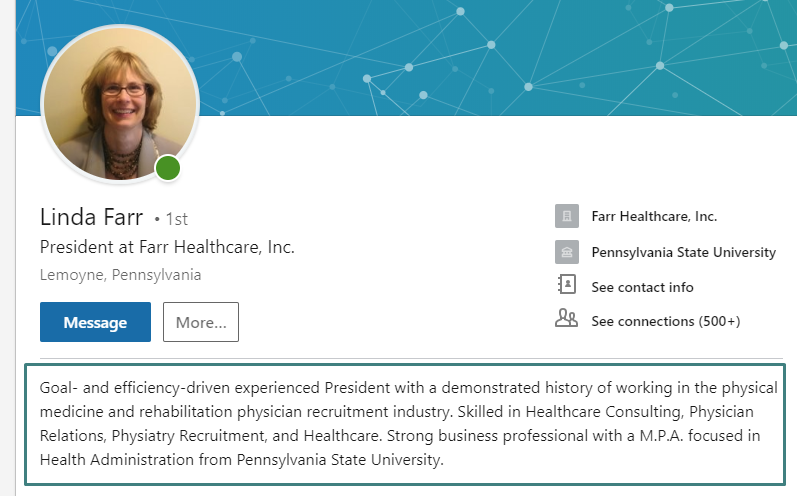
Experience – Use active verbs, show results. Include past jobs and skills – be as robust as possible!
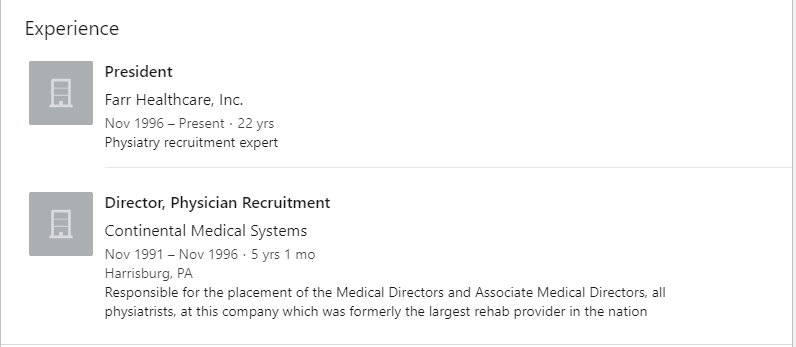
LinkedIn Experience

Education – Be accurate in listing your education. The rule of thumb in professional social networking: it may seem like a vast network of strangers, but the world is truly much smaller than you think.

LinkedIn Education

Contact – Your profile won’t be useful unless you include your contact information! To complete the Contact information section go to the top of your LinkedIn™ profile to the Contact section. To edit it, click on the “See contact info” and a popup window will appear which offers you contact information options. You can also edit this info on your smartphone; the basic information is there but in a slightly different order and layout. Do not make your home address visible. Do not share your birthday, it is a key element for identity thieves, they can guess the year, the month and day are the hardest to guess. Yes, you will receive fewer birthday greetings, but that’s better than having your identity stolen!
Linda's Contact Information

Photo – Include your photo, as profiles with photos are viewed 7 times more!
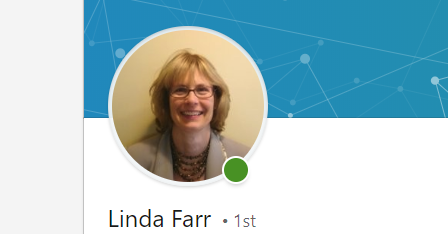
LinkedIn Photo

Skillset – Why should you list your skills? LinkedIn™ allows recruiters and employers to sort by skills, years in the industry and more. Be accurate in your listing of skills.

Privacy settings – Just sign in and then select “settings” from the drop-down menu, where your name appears in the upper right-hand corner. Make sure to be discreet in your privacy settings if you’re looking for a new position so that your boss does not know.

Include Farr Healthcare’s President in Your LinkedIn™ Network

Once your profile is established and you’ve built your network of connections, you will want to continue to update your account on a regular basis. You can do this by interacting through posts, likes, comments and continuing to add people to your network.

If you are a professional in the physiatry field or other medical practice, connect with Linda Farr on LinkedIn™ to start or increase your professional network. As president of Farr Healthcare, she brings more than 30 years of recruitment experience in healthcare — and specifically physiatry — making her an invaluable resource to connect with others in this ever-growing field.

*LinkedIn™, the LinkedIn™ logo and InMail are registered trademarks or trademarks of LinkedIn Corporation™ and its affiliates in the United States and/or other countries.

Physiatrists . . . Why Your CV Causes You to be Passed By

Your job search essentially starts when your cv is reviewed by the hiring entity.  Let me tell you my experience when I receive physiatrists’ cv’s.  Sometimes they have typo’s.  Some are full of typo’s and other times they are cases where you see red marks from Word noting spacing errors, words not being capitalized, etc.  These are minor errors but because the reader sees the red marks they really stand out.  Although it might seem unfair, some employers won’t consider a physiatrist’s cv with any typing errors.

Please remember to include your contact information on your cv.  I think sometimes you have a cv for professional purposes that typically doesn’t include contact information.  This information should be on the top of your cv.  I wouldn’t say that this is a reason you wouldn’t be contacted but it certainly makes it a challenge.

Having too many jobs over too short a time frame is a problem.  I recommend staying at one job for at least 3 years.  However, sometimes it may appear from the way you write your cv, that you’re changing jobs alot when you’re not.  This happens for example when your experience is in one city but you have a multitude of jobs in that city and with various time spans.  You can format this experience to show this by heading it with the name of the city.


Questions to Ask when Pursuing a Physiatry Job

I was recently asked the following questions from an experienced physiatrist about a practice opportunity.

  1. What relations do you have with the local hospitals?
  2. He’s leaning towards the independent contractor affiliation, is there a non-compete clause?
  3. What are you looking for in the new doctor?
  4. What would the pay be as an employee?  He’s an experienced doctor; he’s a CMO.

One of the advantages of working with a physician recruiter is that you have the ability to get answers to your questions so you can determine if it’s the position you want before even submitting your cv.  Sometimes I have the answers and if not, I asked the hiring entity and get the answers.

The first question is a specific one but relates to the general and important question as to where referrals will come from and how sure those referrals will be.  Regardless of whether you’re pursuing an inpatient or outpatient position, it’s a valid question.  Sometimes referrals are fairly certain when they’re coming from a joint venture hospital or internally when you’re considering an orthopedic group.

Location, Location, Location – Is this true for physiatry searches?

Just as I ask graduating residents what states are of interest, it’s logical to consider practice opportunities by the states or interest to you.  I’m not suggesting that you change the states of interest to you.  What I am suggesting is that if there’s a job near a state of interest that it might be worthwhile considering it.  Although you surely can find a practice opportunity in a state of interest to you, there are other very important considerations.

First, although not in order of importance, what job will offer you the most professional growth? If there’s a job near a state(s) of interest to you but offers more professional growth, then that maybe the better job for you.

Second, what job has the best professional collegiality?  Remember that you’ll be at work almost as many hours a day as at home so having a comfortable working relationship is very important.  If you’re unhappy at work, it doesn’t matter that you’re in the state or city, that’s the most of interest to you.

Third, what job has the best physician attrition?  Check the hiring entity’s website to see who is listed versus who is actually there;you can find out the latter often just by calling the office and hearing their recording.  You don’t want a position with a hiring entity that is like a revolving door of physiatrists.

Preparing to Interview a Physiatrist- A Checklist

Here’s some helpful hints about what to do to prepare to interview a physiatrist.  Interviewing requires preparation on both the part of the interviewer and interviewee.

_____ Prepare an itinerary of the visit including the names and titles of who the interviewee will meet with, where they should arrive, what they might need to do upon arrival, etc.  This itinerary should include the complete address of the interview location as well as a cell phone contact in case of any last minute changes.

_____ Prepare your questions.  These should be questions specific to your needs for the physical medicine and rehabilitation position.  Also include psychological questions and situational questions.  Some psychological questions are: If you had to live your life over again, what one thing would you change?  What does success mean to you?  Besides money, what do you value or need most if you are to have job satisfaction?  Some situational questions are:  Describe a stressful situation and how you handled it?  What would you do if the work of one of your team members was not up to expectations?  How do you handle a patient who isn’t satisfied with your services?

_____ If the PM&R doctor interviewee will be staying overnight, have a basket of local goodies in the hotel room.  Speaking of expenses, it’s typical for the interviewer to pay the travel and hotel expenses.

The Most Important Thing to do During a Physiatry Job Interview

There’s a lot to do to prepare for a physiatry interview.  You’ve probably heard and read about what to do from my PM&R website, www.farrhealthcare.com, and many other places.  The most important thing to do during a physical medicine and rehabilitation job interview is to stay calm, cool and collected.

This sounds easy but it supersedes everything else you say and do during your PM&R interview. It’s the underlying theme of your interview.  You can do all the other things to prepare for an interview such as practicing answers to often-asked questions but if you’re nervous during the interview, the content and delivery will not be the same.  Of course, the converse is true that preparation will give you confidence.

Come prepared with some small talk comments if you’re not good with them.  Maybe you can talk about the weather, your trip to the interview, or something that you’ve found out about the physiatrist interviewer’s interests.

Get the itinerary for your visit beforehand so you can become familiar and comfortable with the names and positions of the physiatrists and other people who will interview you.  The itinerary will also inform you of any group interview situations which without knowing beforehand might make you anxious.

Do whatever makes you relax such as repeating a mantra like “I’m confident I will get this position” or do breathing exercises.   Don’t get anxious during the PM&R interview.  A few hours before the interview think positive and visualize how well the interview will go.  There will always be interviews elsewhere if this one doesn’t work out.

When to Start Your Physiatry Practice Search

Most physiatry employers start to look for a new hire in October or November to coincide with the AAPMR Job Fair.  For residents, you can start to look as soon as your senior year starts although many employers aren’t willing to wait for a year.  However, more and more employers now who are in areas that are not as generally desirable or include inpatient rehab work (which is harder to fill) will wait a year.

I don’t recommend passing your cv onto recruiters until you’ve heard about a physical medicine and rehab position and have an interest in it.  Some recruiters will pass your cv on without your knowledge and then you might receive a call from an employer without any foreknowledge.

Don’t worry about being too late!  Although you may not have as broad a range of practice opportunities available, there are many good opportunities available as late as the spring of your senior year.  Also, don’t accept a practice opportunity that is not the best for you just because you’ve set a personal deadline of say December.

Questions to Ask During an Interview with a Physiatry Rehab Program

Be prepared to answer and ask questions during a physiatry job interview.  The type of PM&R work associated with the job such as inpatient, outpatient, or pain will determine some of the questions you should ask.  When interviewing for a mostly inpatient physiatrist position, some of your questions should be as follows and I’ve included further information so you can better evaluate the answers provided.  I usually obtain this information from the employer to save your time and provide as much information to you as possible.

What is the average daily census?   If the census is significantly below the bed size, then you should ask why.  If they respond that the current physiatrist isn’t doing his/her part to fill the beds, then you need to evaluate if it’s truly the PM&R doctor or if instead the system that could be doing a better job in this regard.  You might also want to find out what are the possibilities are for the program to expand.

Who is the primary doctor for the patients?  This answer will help you determine your responsibilities and if you are comfortable with them.  More and more rehab facilities are adding hospitalists to provide the patient’s primary care.  You should also find out the availability, such as on weekends, of any of the doctors who support you.

Who are the referral sources? It’s great if there are built-in referrals sources however this usually isn’t the case with inpatient physiatry work.  Find out how well the marketing liaison program is. Try to determine how much daily time will be spent to develop a patient base.

Add Your Employer Contact InfoFill Out an ApplicationCheck Out All Our Job Openings

Interviewing-Learn what’s not in the practice opportunity description

Just as important as what’s in writing about the practice opportunity you’re considering is what’s not written about the practice opportunity.  The “hard” features of the practice opportunity such as the compensation, responsibilities, and benefits are usually in its description.  The “soft” features such as the personality they’re looking for, the practice dynamics, goals, needs, etc. are not.  How do you learn the unknown?  A clue can be to find out the personalities/capabilities of the current doctor(s)/hospital representatives in the practice.  Social media and other websites can give some insight.  Find out the experience, certifications, tenure with the practice, and accomplishments of the practice doctors/hospital representatives.  This information will also help you determine how you should engage with the practice/hospital; knowing the current personalities will help determine the type of dialogue to have during your interview.

On the other hand, the practice/hospital may be looking to bring a new personality or new capabilities.  If you’re working with a physician recruiter, he/she can help to find out.  The direct approach of asking the practice/hospital representative directly what they’re looking for in the newly hired doctor will show them that you’re confident and knowledgeable in the interview process.