Physiatry Supervision of Ancillary Staff

A physiatrist asked me recently about the supervision of ancillary staff.  He was asked to start supervising ancillary staff as part of his job.  He asked me how much he should be paid additionally to do this.  He had a concern about the litiguous position it might put him.  I’m not familiar with this subject so I asked a Bruno Stillo, a colleague and owner of Physiatry Billing Specialists, and he also was not familiar with this circumstance.  A reference on this subject was found on the web, https://www.michaeljohnsonlegal.com/physician-compensation-supervision-npp/  It says that physician supervision is VERY profitable to employers and that as a physician you should not provide this supervision without a fair compensation.  You should have the foresight include language when you’re negotiating a contract to exclude this supervision.

Physiatrist working with a physician's assistant

Employers may offer to allow you to record your time spent supervising and pay you on an hourly basis. However, if you look closely, the hourly rate they are willing to pay is often lower than what you make per hour already, such that adding more time to your day would result in a diminished marginal rate of compensation. Said another way, if your first 40 hours (likely more) of work in a week pays you $175/hour, and the hourly rate for supervision your employer offers to pay is $150/hour, then it is not in your best financial interests to do agree to do more work.

The article goes on to discuss other compensation methods.  Their bottom line is to be careful and to not be taken advantage of.

Physical Medicine and Rehabilitation Doctor Supply

It seems everyone wants to add a physiatrist to their practice, hospital, etc.  There are so many physical medicine and rehabilitation jobs on ourwebsite.  Interventional physiatry jobs are also plentiful.  Who’s going to fill all these openings?  What’s the supply of physiatrists in the US?

Physical medicine and rehabilitation doctor supply with pictures of doctors

The number of medical school applicants from 2018 to 2019 increased by 1.1%.  This very small increase doesn’t bode well for physician supply in general.  Many more physicians, to include physiatrists, are needed to fill all the physical medicine and rehabilitation jobs.  Medical school enrollment from 2002 to present is 52% higher.  This seems to be a good trend but one that really needs to escalate at a faster pace.    My understanding is that all but one PM&R residency spot was filled this year.  The competition for physiatry residencies is ever increasing although it isn’t high relative to other specialties.

An NIH study titled Physiatry Workforce in 2019 And Beyond said that 37% of the 8,853 physiatrists surveyed indicated that their physical medicine and rehabilitation job workload exceeded capacity (maybe burnout), 59% are working at capacity and 4% under capacity.  There was a national shortfall of 940 physiatrists in 2017.  From 2017 to 2030, the projected growth in physiatrist supply will approximately equal the demand.   However in 2030, there will be a shortfall of 1,080 physiatrists unless there’s a change in delivery.

What does the supply of physical medicine and rehabilitation physiatrists look like?  The average age of a physiatrist is 40 years old.  The largest percentage, approximately 35%, of PM&R doctors stay in their job 1 – 2 years with 18% of physiatrists staying in their job 5 – 7 years.  The states with the most physical medicine and rehabilitation doctors  in the U.S. are NY, FL, TX and CA and SD, WY, AK, VT have the least number of physiatrists.

It’s much more difficult to find candidates for physical medicine and rehabilitation jobs to include interventional physiatry jobs than it was years ago.  Now even highly desirable areas like NYC and San Diego request outside recruitment help.  Twenty years ago, Farr Healthcare, Inc. was recruiting inpatient and TBI/SCI/general outpatient physiatrists; 15 years ago interventional positions were added; 5 years ago to now subacute, pelvic rehab and telemedicine have been added to the mix.

Most residents go into interventional physiatry jobs for many reasons to include their interest in the field, their student loans and to expand their service capability.  Covid caused many physiatrists to retire.  Some rehab hospitals are using internists because of the lack of supply in physiatrists.  There is less interest among physiatrists for inpatient work because of the paperwork, dealing with insurances, call, etc.  The younger physiatrists are looking for a work/life balance and for that reason some of them are going into outpatient, subacute, and skilled nursing facility work.

Please check out physical medicine and rehabilitation practice opportunities here.

Physical Medicine and Rehabilitation Jobs and Physiatry Supply

I can’t say enough about the abundance of physical medicine and rehabilitation jobs compared to the number of available physiatrists.  There was a study done in 2019 about the physiatry workforce in 2019 and beyond.  Thank you to all the physiatrists who participated in this study which was published in September, 2021.  We are still seeing this trend in 2023.

chart physical medicine and rehabilitation jobs

Process:  They developed and implemented an online survey of board-certified physiatrists (n = 616 completed, 30.1% response) to collect information about demographics, practice characteristics, hours worked, and retirement intentions. Microsimulation models projected future physiatrist supply and demand using data from the American Board of Physical Medicine and Rehabilitation, national and state population projections, American Community Survey, Behavioral Risk Factor Surveillance System, Medical Expenditure Panel Survey, and other sources.

Results: Approximately 37% of 8853 active physiatrists indicate that their physical medicine and rehabilitation job workload exceeds capacity, 59% indicate that workload is at capacity, and 4% indicate under capacity. These findings suggest a national shortfall of 940 (10.6%) physiatrists in 2017, with substantial geographic variation in supply adequacy. Projected growth in PM&R doctor supply from 2017 to 2030 approximately equals demand growth (2250 vs. 2390), suggesting that without changes in care delivery, the shortfall of physiatrists will persist, with a 1080 (9.7%) physiatrist shortfall in 2030.

Conclusion: Without an increase in physiatry residency positions, the current national shortfall of physical medicine and rehabilitation physicians is projected to persist. Although a projected increase in physiatrists’ use of advanced practice providers may help preserve access to comprehensive physiatry care, it is not expected to eliminate the shortfall.

Don’t miss the Openings page on the Farr Healthcare website for physical medicine and rehabilitation jobs.

The New York Society of Physical Medicine and Rehabilitation Job Fair

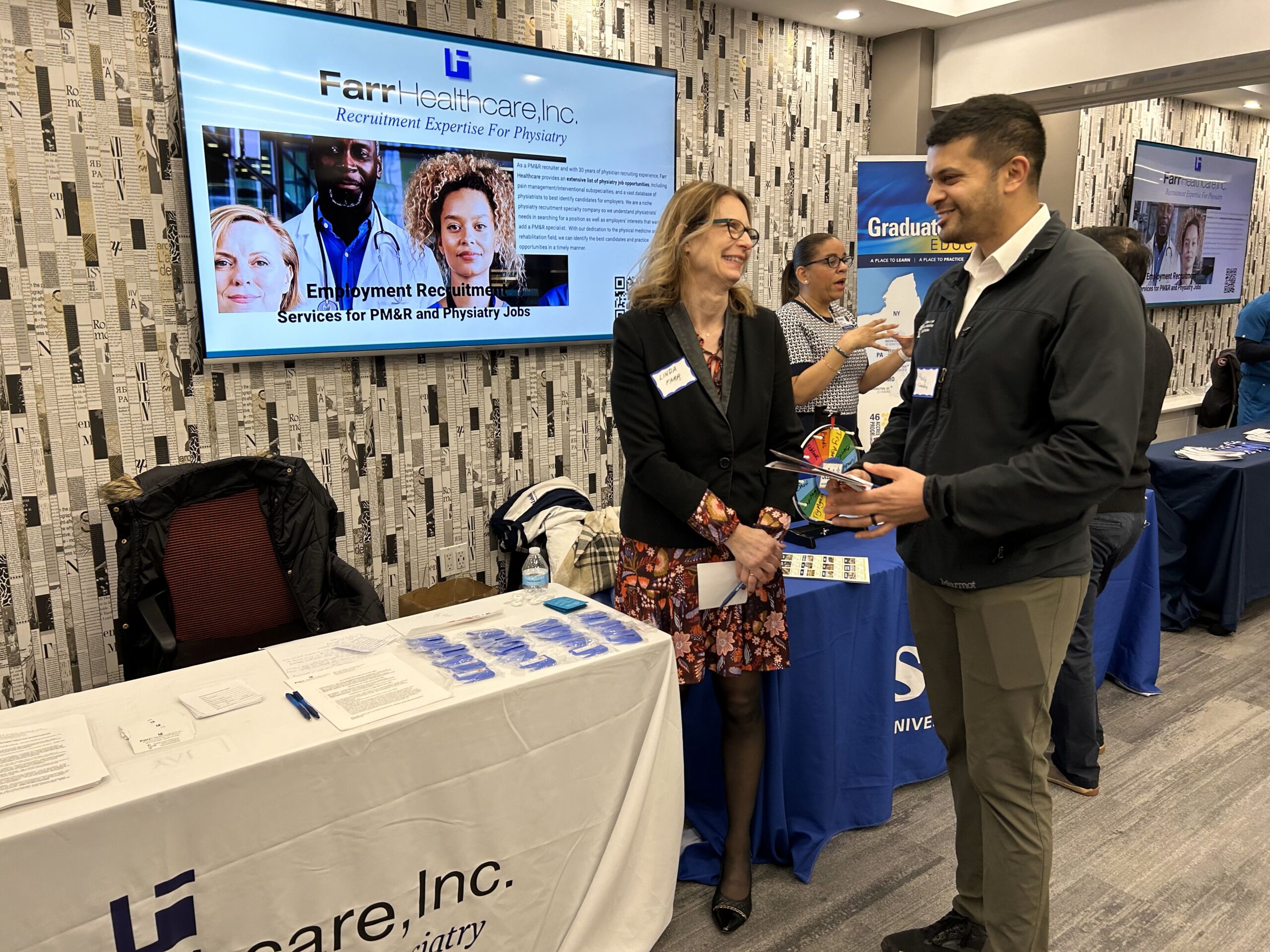
I had the good fortune to attend the New York City Physical Medicine and Rehabilitation Society Job Fair last week.  It was great to meet the doctors who attended.   It was a fun night.  Thank you to those who organized it and who stopped by my booth.  I wish everyone the best in their practice search.

picture of Linda Farr at the NY physiatry job fair

Physiatry Compensation and Bonus – RVU-based versus Income-based

With RVU-based compensation and bonus, either the practice or the employee may be shortchanged, as follows:

Practice has many low-reimbursing payors – Practice is short-changed

In practices with many self-pay (often becomes no-pay) or Medicaid patients (with its lower reimbursement), the practice may be shortchanged by tying compensation and bonuses to RVUs. Although the employed physician meets his RVU work requirement, the lower reimbursement will result in lower practice income which may be insufficient to cover the physician’s compensation and bonus.

Practice has many traditional reimbursing payors – Physician-employee is short-changed

In practices with a payor mix of traditional carriers (Medicare, BCBS), the employee may be shortchanged. Presuming the same level of RVUs are achieved (as in the above example), the practice’s higher income may far exceed the physician’s compensation and bonus

Article about physiatry relative value unit with picture of bonus in words
 

Opinion

I prefer physician-employee compensation and bonuses which are based on income generated by the employee, and not based on RVUs.

  1. RVUs is a nebulous, difficult to understand term, but dollars and cents is a universally-understood language.
  2. The more or less income the practice earns based on the employee’s services, the more or less compensation and bonus the employee gets.

Stated plainly: Pay me based on what income I generate, not the number of hours (which will increase RVU’s) I work.

This article Was contributed by Bruno Stillo, Physiatry Billing Specialists. 800-835-4482,  physiatrybillman@aol.com

Looking for a Physiatrist? Farr Healthcare, Inc. Physiatry Recruitment Has Them

Although there is a physiatry shortage, there are many physiatrists looking for work.  These PM&R physicians may, or may not, have an interest in your area or the type of work you have, be it inpatient, outpatient or interventional.  Check below to see if one of these physical medicine and rehabilitation doctors is a match for your position. Many more physiatrists are available so if you don’t find one here, please contact us.

ARticle about available physiatrists with picture of doctors

  1.  An outpatient physiatrist is looking for work in eastern NC
  2. A 2024-graduating resident is looking for outpatient work in the Baton Rouge area. Many more 2023-graduating residents and fellows are available.
  3. An inpatient physiatrist is open to most areas and wants to be the consultant, not the primary doctor
  4. A physiatrist is looking for telemedicine work
  5. An interventional physiatrist looking for any type of work but on a part-time basis in IN and surrounding states
  6. An inpatient physiatrist looking for Medical Director work as an independent contractor in GA
  7. An inpatient/outpatient physiatrist who wants MI,OH,IN, or TN
  8. An inpatient/outpatient physiatrist who wants to work in the Houston area a few days/week, every other week as an independent contractor
  9. An interventional physiatrist who wants NJ or NY
  10. A 2023-graduating sports medicine fellow who wants in or near Atlanta; Philadelphia; Washington, DC.; Miami, Jacksonville, Orlando, or Tampa Bay, FL;Denver; San Diego; NYC; Phoenix; Salt Lake City; Chicago; New Orleans; Nashville; Austin, Dallas, or Houston; Boston; Seattle; or Charlotte

Maybe you’re looking for work.  If so, please refer to practice opportunities here.

Latest Physical Medicine and Rehabilitation Statistics

Here is some current information on the landscape of physiatry today.  The field continues to grow!  It is now attracting even more qualified medical students.

Article about physical medicine and rehabilitation statistics with picture of doctors

STATISTICS – as of 3/2025

 Total number of Board Certified physiatrists – 15,096

Physiatry residency programs:  90

Number of ACGME-accredited Fellowship programs:  sports medicine – 141, spinal cord injury – 25, pediatric rehab – 25, traumatic brain injury – 27, neuromuscular medicine -4, and hospice and palliative medicine – 3, pain – 109

BOARD CERTIFICATION PROCESS

Part 1

The written exam is administered annually in August.  It can only be taken post-residency.  Applications must be received by the preceding January.  498 first-year graduates took the exam on 8/2024.  86% successfully passed the examination the first time.  This is the historic pass rate.

Part II

The oral examination may be taken only after one year of clinical practice fellowship, research, or a combination of these activities in PM&R is completed following residency.  The exam can be taken in May; the deadline for registration is the preceding November 15th.  444 first year graduates took the exam on 5/2024.  88% successfully passed the examination the first time.  This is the historic pass rate.

Candidates must satisfactorily pass both the written exam and the oral exam in order to be certified by the American Board of Physical Medicine and Rehabilitation.  A physiatrist must be recertified every 10 years.

FARR HEALTHCARE DATABASE – as of 3/2025

  • 14,798 physiatrists with practice and area preferences for most of them
  • 5,772 email addresses

Please refer to Farr Healthcare, Inc.’s website for information about physical medicine and rehabilitation practice opportunities and more.

Executive Physiatry Medical Director Compensation

Recently a physical medicine and rehabilitation physician asked me the average compensation for an Executive Medical Director job.  The vast majority of the physical medicine and rehabilitation positions we represent are clinical, not executive.  According to salary.com, the average Executive Medical Director salary is $359,636 as of December 27, 2022, and the salary range typically falls between $295,670 and $446,617.

One of the many current clinical Medical Director positions available now through Farr Healthcare, Inc. is in the Houston area.  This rehab hospital has great clinical outcomes and an outstanding reputation in the market.  For more information about this physical medicine and rehabilitation practice opportunity and many more may be found at www.farrhealthcare.com.

WHAT DO I SAY TO EMPLOYERS ABOUT A PHYSIATRY CAREER GAP?

This is a tricky question.  Some physical medicine and rehabilitation doctors don’t address it on their curriculum vitae.  Some doctors don’t explain it on their cv but explain it in a cover letter.  Other doctors don’t address it unless the employer notice the gap on their cv.  What should you do?

It depends on the reason for the gap in your professional physiatry timeline.  It could be due to illness, the time spent looking for a new job, time spent caring for a family member, provided childcare, loss/suspension of a license, etc.

Some reasons are professionally acceptable but others like taking the time to find a new PM&R job usually raises a red flag.  If the former, let your cv show that your gap isn’t a red flag.  There’s a degree to which the reasons for a gap are acceptable.  Anything that impacts your license is unwelcome to employers.  There is no way to successfully explain this gap.

Regardless of the amount of time you weren’t working in physiatry, it has to be addressed on your cv.  If the reason for your gap time is one of the less acceptable reasons, it might serve you well to explain it in detail in a cover letter.

Thinking that your gap won’t be found is not facing reality.  Instead, it will cause a delay in your obtaining a physiatry job while at the least the discussion about it ensues.  At the worst months will go by in your practice search process and then you will be stopped in your tracks when the gap is discovered and rejection occurs and you’re back to square one.

Regardless of the length of the gap in your physiatry timeline, it should be included on your cv.  Of course, normal vacation time is understood.  Your cv should include the month and year of every entry in your education and experience sections.  Hiring entities, hospitals and payors are very attentive to this information.

Honesty is the best policy.  Whatever stress if any you may have gone through during the gap time, being honest on your cv will reduce any further continued stress for you.  The less stress you feel, the better you will do in the physiatry practice search.

Preparing to explain the gap is paramount.  How to explain a license issue is best done by providing the information from the license board.  You can explain your side of the issue in a cover letter.

Each reason for a gap is individual so it’s hard to offer an acceptable explanation to you.  Explain your gap and move on.  Don’t dwell on it in your explanation.  Focusing on it will only make it a bigger issue.  Focus instead of your desire and readiness to return to the workforce.  Stay calm.

Took time looking for a new job

You can give examples of how you have been proactive but selective about looking for a new physical medicine and rehabilitation job during your career gap. Show how you have thought about what you want from a new job as well as from a new employer. Explain why you think this particular position is a good fit for you and why you would be a good fit within the company at large.

Became a stay-at-home parent 

Explain that you took time out to prioritize your family and look after your children. Elaborate on why you now feel ready to go back to physiatry work. Why are you excited about this new phase in your life? Provide details that can prove you are a good fit for the position. Also, make sure to show closure, e.g., the kids are grown and in school. Employers know that family is important, but they also want to be reassured that you won’t treat your role as secondary.

Left the workforce to be a caretaker

There is no need to go into the details of the illness or your responsibilities as a caregiver during your physiatry employment gap. Just like taking time off to be a full-time parent, make it clear that your relative has recovered or you have more support in place at home and can reenter the workforce with no obstacles.

Personal illness

Illnesses and injuries explain career gaps in employment very easily. But, make sure to clarify that these ailments won’t get in the way of you working efficiently. Again, there is no need to provide specific details of the illness or injury unless it directly affects the job you are interviewing for. Show that you are ready and more than willing to return to work, emphasizing why you think the physiatry position you applied for is a good fit.

Took time off to travel

Expound on why you decided to go travelling. If you learned anything through this experience, now is the best time to talk about it. Stress on points such as personal development, better cultural awareness, and gaining new perspectives. At the same time, make it clear that you are ready to return to work full-time. So, also talk about why this particular PM&R job opportunity excites you.

Got fired

Explain that you and your former company had different expectations. Show how you realize that you could have handled some things differently, but through the entire process, you have learned a lot and are excited about the new physiatry opportunity to bring everything you have learnt to your next job.

Got laid off

Briefly talk about why your previous role was made redundant, e.g., budget cuts.  Provide examples of key achievements and strong performance while you were in your previous physiatry job. Take time to explain what positive things you have been doing such as moonlighting or locum tenens since having left your previous employer and why you think the position you applied for is a good fit.

Relocation

Relocating from one geographic area to another is a reason why you would have a career gap in your physiatry curriculum vitae. The best strategy is to tell the employer how you spent your time while unemployed, highlighting positives gained rather than the negatives.   https://www.jobstreet.com.my/career-resources/job-hunting/career-gaps-explanation/

For more information about cv preparation, please visit here.  Featured at the 2021 virtual Annual Assembly, special guests Monica Rho, MD, FAAPMR and Linda Farr, MPA discussed tips and tricks for virtual interviewing and how to compose a winning CV. Note: These sessions are only available for viewing by AAPM&R members.

For practice opportunities with Farr Healthcare, Inc., please visit here.

 

What a Treat to See Everyone Again at the 2022 AAPMR Meeting!

It’s been a few years since an in-person AAPMR meeting.   It was great to see everyone at the 2022 AAPMR meeting who stopped by my booth at the Job Fair and/or at the Exhibit Hall.  I look forward to seeing all of you next year!


One lucky person won the $500 door prize that we award each year.  This year’s winner was Eduardo Lamas Basulto, M.D., a resident from Emory.  Congratulations, Dr. Lamas Basulto!